Bongdaesan Fire Squirrel
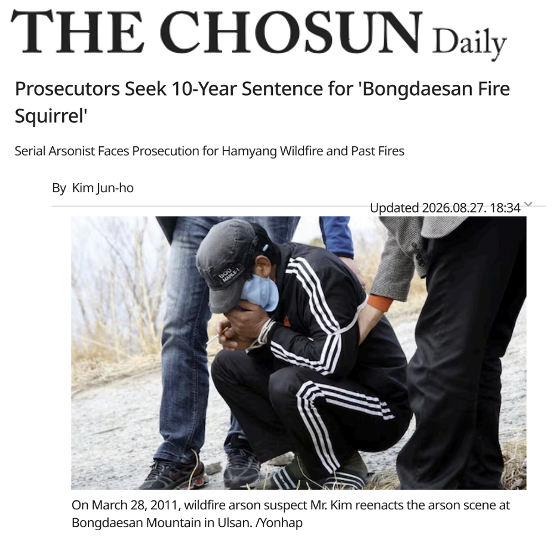
Recently, SWAIT contributor Ed Nordskog worked with a South Korean news team producing a documentary on Serial Arson, and in particular, Serial Wildland Arsonists. Nordskog provided expert analysis and profiling information in a general sense and then analyzed a unique case known in South Korea as the “Bongdaesan Fire Squirrel”. This case was a fascinating look at a lifetime wildland serial arsonist. This following case history/analysis was compiled from news stories (article link) and detailed information provided to Nordskog by the lead investigator on the case, Head Inspector for the Provincial Region, Mr. Jeong-min Seo.
In January-February 2026, authorities in the coastal mountain region of Hamyang, in South Korea noted an uptick in forest fires. The fires grew large and dangerous due to dry conditions, very dry fuel, and high winds at that time of year. Investigators formed a task force to investigate these events and put out a plea for help to the local communities. Early in the case, a village official in the region notified the investigators about a suspicious local man. The official described the local man as a notorious serial arsonist known as the “Bongdaesan Fire Squirrel”. The man, whose name is Jeom-yeol Kim, earned this nickname for a series of wildland fires he previously ignited in the region.
Kim was arrested and eventually convicted for 37 of the 96 wildfires he set over a 17-year period from 1994-2011. The nickname “Squirrel” was assigned to the unidentified arsonist in the middle of the series for his uncanny ability to avoid identification and arrest for so many years, and his ability to quickly move about the forest without getting caught. Kim was able to avoid detection because he had an alibi for many of the fires that occurred, as he was with others at his home when the fires were first reported. Through extensive analysis of CCTV systems, Kim was linked to several fires. He was arrested in 2011 and eventually admitted to nearly two decades of setting wildland fires.
Upon his conviction in 2011, he was sentenced to 10 years in prison. Kim was released from prison in 2021 and eventually moved to the Ulsan area (a large coastal city). He married and obtained a decent job and became active in his church. He was 67 years old when this latest wave of fires was recognized.
Once investigators realized a notorious wildland arsonist resided in the same region as the suspicious forest fires, they focused many of their efforts on him. They again turned to the use of the high-quality CCTV surveillance system.
The investigators began using these cameras to compare Kim’s activities to the fires in the area. They noted that he routinely took walks from his home into the woods during the evening hours. Kim was healthy, mobile, and could easily walk several miles. In more remote areas where Kim had driven his car to a forested tract, they saw him leave for a period, but he was always back in view of a camera long before any fires were detected. However, investigators did note that his hikes and disappearances coincided with the same days of many of the suspicious fires. They began to suspect that he may be using some sort of time delay incendiary device to ignite his fires.
While monitoring Kim, investigators noted that he routinely took evening walks into the forest that lasted from 20 minutes, up to an hour. He usually brought a dog with him. He could easily walk more than a mile in those time frames.
Investigators also completed a detailed background assessment of Kim. He was a fit 67-year-old. He was a devout Christian and often assisted more elderly persons in his church who had mobility issues. He had a family and a stable job. He hardly fit the “accepted profile” of a serial arsonist.
Investigators also employed geo-spatial analysis and temporal analysis techniques in this current case. They plotted Kim’s activities on a map, his hikes, his home, and the locations and times of the suspicious fires.
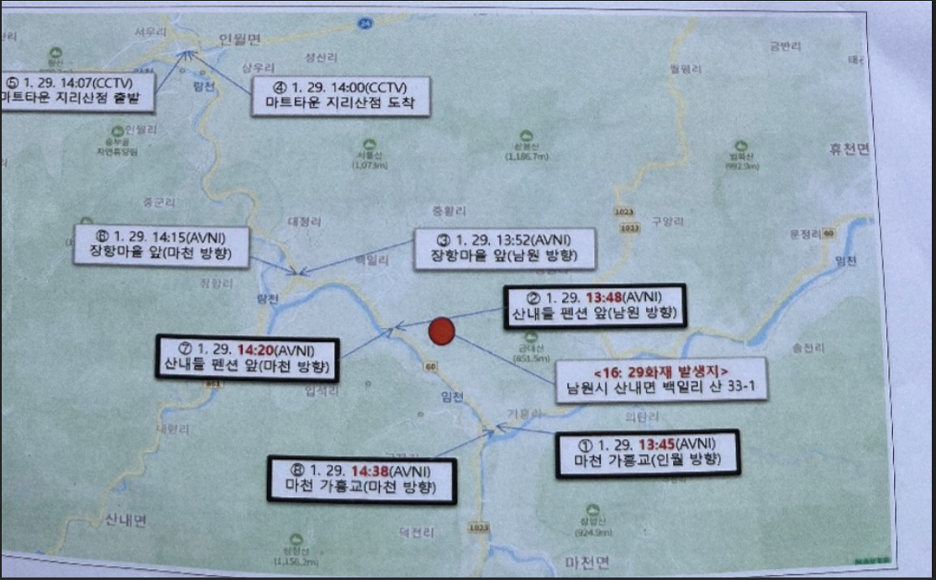
Geo-Spatial and Temporal plots from South Korean investigation file
In combining all the above information, the investigators confirmed that the arson/suspicious fires coincided exactly with the movements of Mr. Kim. Considering his background, which consisted of 96 other fires, the investigators were able to get a search and arrest warrant for Kim. They made their arrest in March of 2026 for this latest arson series.
After his latest arrest Kim gave a full statement to investigators. He said that he missed the days of his youth on a rural farm when he and his father routinely set fires to clear acreage. Kim said when he left prison after his previous arson conviction, he heard news coverage of recent wildfires and felt an “exhilaration”. He said that created an “urge” in him to set some of his own. He described waiting for the dry, windy winter months because he knew through experience that large fires were easier to ignite in those conditions. Kim accompanied investigators to the scenes of his fires and described in detail his fire setting.
The Incendiary Device:
Mr. Kim then described for investigators an improvised delay incendiary device he had created that would give him a lengthy time delay to get out of the forest and be home before a fire ignited. Kim even fashioned one of these unique devices for investigators when he took them to the fire scenes. The investigators noted that this device created by Kim matched the burned remnants of at least one similar item found at a fire scene.
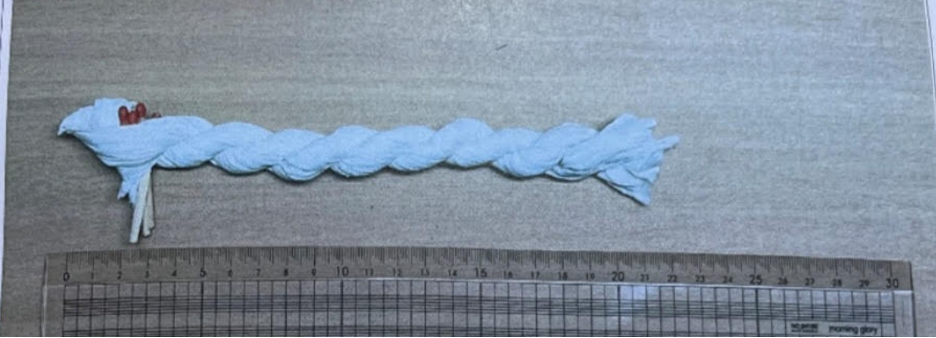
Arson device from the South Korean case file
The above device consisted of very tightly braided toilet tissue, approximately 6 inches in length with 4 wooden matches inserted into the end of the device. Mr. Kim described that depending on the length of the braided tissue, it could give him a significant time delay before the matches ignited and transferred flame to the nearby dry vegetation.
Mr. Kim elaborated that he carried folded toilet tissue in his pocket (so as not to arouse suspicion) and then constructed the device at the fire scene. In placing the item, he buried the end with the matches in dry leaves to ensure ignition. He also told investigators that the exterior of the paper “rope” burned without a visible flame.
Searches of Mr. Kim’s home and vehicle produced no finished devices, but several bundles of folded tissue. Combining Kim’s statements and field tests of their own, investigators determined that the “rope” tissue would burn for upwards of 1.5 hours, depending on the weather and surrounding vegetation.
Korean investigators did not think this incendiary device was unique or rare based on Mr. Kim’s background. They explained that braiding straw rope is a common activity among rural people from Mr. Kim’s age group.
Mr. Kim was convicted of this latest series of fires and was sentenced to 12 years in prison. (article link)
Case and Incendiary Device Analysis by SWAIT Contributors
Mr. Kim appears to be a lifelong serial arsonist, with most of his fires occurring in the mountains and forests near where he lived. Korean authorities and the media found it extraordinary that a genial man of his age, who was also married, maintained a stable job, and purported to live his life as a “Christian by helping others”, could possibly be a serial arsonist. This didn’t shock us at all.
We have looked at nearly 1,600 cases of serial arsonists, with around 400 of them being wildland serial arsonists. No two of them are exactly alike. Nothing surprises or shocks us about any of them. There is no singular “profile” or norm for a serial arsonist. Age is not a factor, other than when it limits the mobility of the arsonist. While most serial arsonists tend to have tumultuous lives affected by mental health problems as well as substance abuse issues, there are also many who don’t have such issues. Hundreds of past serial arsonists have lived seemingly normal lives, maintaining families and a job (John Orr is an example).
Mr. Kim’s case is extraordinary compared to other serial arsonists in different ways. Kim, even at an older age, was very fit and highly mobile. He took long walks into the forest and was quite comfortable being well off roads and deep into the woods. In contrast, the overwhelming number of wildland serial arsonists commit their acts along roadways, with few of them venturing far into the wilds. Many serial arsonists would not be considered physically fit. Kim’s fitness and agility allowed him to quickly move about the area. He was very familiar with the nearby forests and was well known to many people who worked in or frequented the forest areas.
Kim was clever enough to include bringing a dog with him several times so as not to appear suspicious while walking along trails.
Kim also had an appreciation for the use of CCTV’s in his town. He knew from his previous arrest that authorities could follow some of his movements via security cameras, so he designed this long-term delay device to use the CCTV’s to his own advantage. They recorded him being at home at the times the fires ignited. He is one of the very few serial arsonists to purposefully conduct “counter forensic measures” that would ensure a visual alibi for himself.
The investigation by South Korean authorities was exemplary. Although not well known as a nation with a serious wildland arson problem (like Australia, Canada, US, and Southern Europe), the investigators followed modern protocols to build a strong case against the suspect. They used information from the public, modern security cameras, surveillance operations, geo-spatial and temporal analysis techniques, and incendiary device analysis. All this led to them building a decent case before confronting Kim with his activities. This case building resulted in Kim giving a full confession to several large arson fires and even re-creating the events with investigators.
The Incendiary Device:
The device used to delay the ignition of the fires in Kim’s case was incredibly sophisticated in its simplicity. It was hand-fashioned out of innocent and common materials that were purchased for practically nothing. He carried normal toilet tissue folded in his pocket, that if he was stopped and searched would cause no suspicion on Kim. At the scene, he could quickly braid the tissue into its rope-like configuration. He gave it the desired length based on how long of a time delay he needed. He then placed multiple wooden matches into this item, covering them with dry vegetation and leaves, and then ignited the opposite end with a flame source.
Kim admitted to using these items multiple times and told investigators the braided material burned without visible flame, and that typically the ashes from this item blew away in the winds after ignition, leaving no visible evidence. However, Korean investigators had located burned remnants of at least one such item.
At first, SWAIT device experts considered this an extremely rare and unique device, not typically seen in North America. However, Korean investigators clarified that the weaving/braiding of straw in the rural areas of Korea was common in past decades. This revelation, along with the fact that Mr. Kim was born and raised on a farm, explains where he likely learned how to make such an item.
Historically, this sort of item has not been seen in arson cases since the early 1960’s. Our research has shown that a very similar design of incendiary device was found hundreds of times in the Western range/ranch lands of North America from the early 1900’s until 1960’s. This was a type of item frequently used by ranchers to annually burn grazing lands. When this practice became illegal, the ranchers resorted to using these delay devices to give them an alibi by being home when fires were reported. In many cases, they used these devices in conjunction with lightning storms to blame range fires on lightning.
Below is one such device found in old files dating back to the 1930’s in the American West. The American version of this device uses hemp rope instead of the braided tissue by Mr. Kim, but the result would be the same. Occasionally the rope fuse would have some slow burning oil or even gunpowder poured onto it.
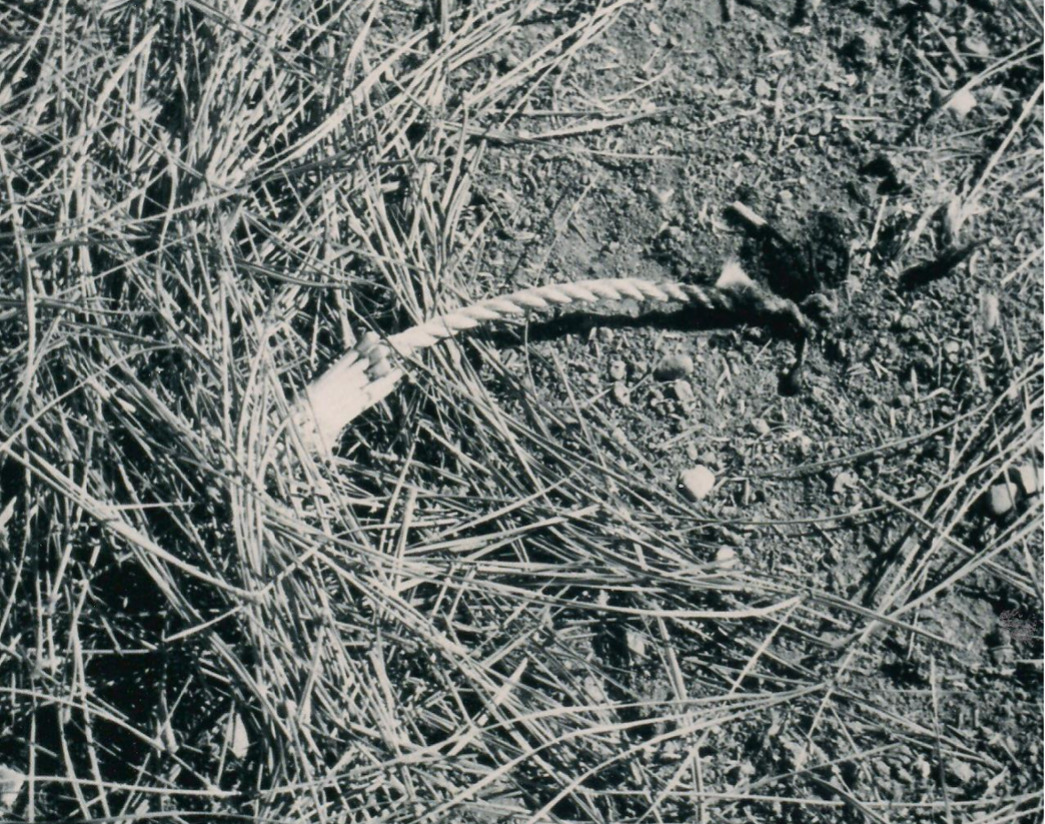
Photo courtesy of John Maclean (paper match on the right, rope fuse, bundle of wood matches placed into dry pine needles)
By all the above information, we would rate Mr. Kim as a highly skilled, and very experienced serial arsonist. He waited until the worst time of year to set his fires for maximum effect. His skills were far above the norm for other wildland serial arsonists. He is an incredibly dangerous person.
SWAIT Experts:Ed Nordskog, Joe Konefal, Scott Fischer